Azerion Knowledge Base

Morklav

Introduction The patron goddess of necromancers. Morklav worship is proscribed across much of Jhordunne and is punishable by death in the Empire. The Black Inquisition currently hunts necromancers and Morklav worshippers. While most who follow Morklav are necromancers, there are also those who seek undeath. Though the Aelferii do not worship Morklav, they are not

Morklav Read More »

The Afterlife

As difficult as life is on Jhordunne, death is no better. Once free of earthly bonds, the deceased have to worry about greedy necromancers, warring gods, and things that feast on spiritual energy. Most sentient beings on Jhordunne are made up of three parts: Körprisch, Absicht, and Geistun. These three parts give the being physicality,

The Afterlife Read More »

Ludger

Ludger Introduction Ludger is the god of assassination, blood, and cruelty. He is an unforgiving god, who cares little for his adherents, save that they server him without question and provide him with animae in the form of assassinations or ritual murders. Thieves, assassins, and common murderers often worship him. Depiction Ludger’s depiction varies by

Ludger Read More »

Ostara

Introduction Ostara is the goddess of Death, Fate, and Prophecy, She is the mother waiting in the afterlife. Death, be it from natural causes, an accident, disease are her realm. Honorable deaths in combat also fall to her. It is she who decides who will stay in her realm, to serve her, and who will

Ostara Read More »

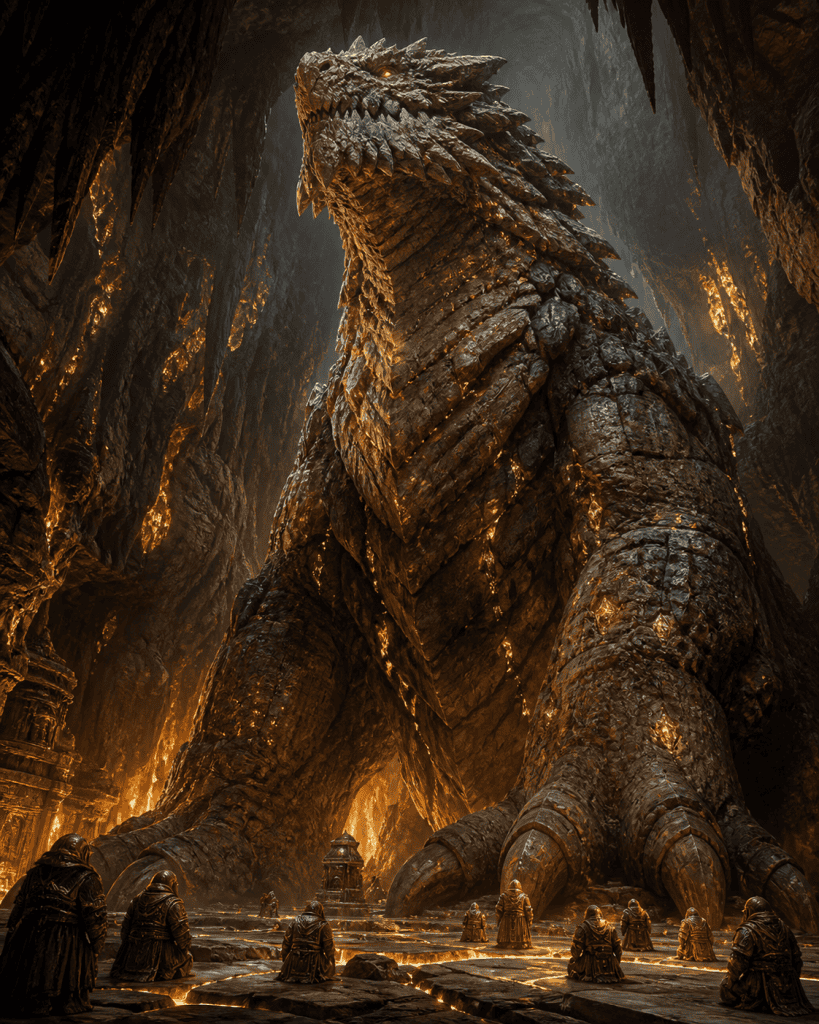
A colossal grey-brown wingless dragon of immense scale, far larger than any natural creature, emerging majestically from deep within a mountainous underground cavern. The dragon's massive body is encrusted with rock, stone, and earth, its scales resembling layered sedimentary stone and ancient granite. Its enormous feet press into the cavern floor, causing visible cracks and tremors radiating outward. The environment is a dramatic underground realm with towering stalactites, glowing veins of precious minerals embedded in cave walls, and deep shadows broken by warm amber and orange light emanating from molten rock below. Small dwarf-like figures in stone-carved armor kneel in reverence at the base of the creature, dwarfed entirely by the divine being's overwhelming scale. The atmosphere is ancient, sacred, and primordial. The color palette consists of deep browns, charcoals, slate greys, and flickers of gold and amber from mineral veins. Epic fantasy digital art style, highly detailed, cinematic lighting, dramatic perspective looking upward at the towering deity.

Aberron

Introduction Aberron is the god of the land, of stone and earth. It is primarily worshipped by those who work with rock or stone, such as miners or stonecutters. It is especially popular among the Zwergen (Dwarves). Depiction It is depicted as a grey-brown, wingless dragon, immense in scale and far larger than any dragon

Aberron Read More »

The Wither

Following the First Migration, the Aôlerian settled in lands they named Toriath, which means “Prosperous Home” in the old tongue of the Elves. Toriath was home to many Fey, that most ancient race of beings that had called Jhordunne home for millions of years. For millennia the two lived in harmony, with the Fey teaching

The Wither Read More »

Af’kir

Rarely referred to by its formal name, Af’kir is more commonly known as The Land of the Ancients. This long, narrow, curved continent was home to some of the oldest civilizations on Jhordunne: the reptilian Ch’kari in Ankre Ssaln, the Aôlerian in Toriath, and the Chthonic Empire in what is now called Chthonia. Finally, there

Af’kir Read More »

Scroll to Top